Showing posts with label Comprehension Strategies. Show all posts

Wednesday, January 7, 2015

Toolkit Training

I was asked by my reading coach and principal to provide a training to our staff on The Primary Comprehension Toolkit after break. Of course, I jumped at the opportunity - thrilled that we were going to beginning the implementation of these amazing resources which I have been raving about since my interview. So over break I've been rereading the teacher's guides, going through my supplemental resources, and even picked up a copy of Staff Development with Comprehension Toolkits: Implementing and Sustaining Comprehension Instruction Across the Curriculum. So needless to say - by desk has been covered with these bounteous texts.


After many hours of reading, highlighting tabbing, digesting, quoting, typing, revising, and editing I've ended up with a pretty good presentation. Because I used some of the slides from the Staff Development book I can't publish it here.

But to sum it up my presentation included:
- An Introduction to Comprehension Strategy Instruction
- An overview of each strategy, with a activity to launch it that teachers could take back to their classrooms (most came from Comprehension Connections), and an opportunity to look at and discuss student work with the strategy
- A walk through of the Toolkit components
- A modeled lesson
- and  time for PLCs to dive into the materials

This will be my first formal training at my new school and I am so excited to be sharing a resource that I love! Here it goes .  . .

--------------------------------------------------------------------------------------------------------------------------
UPDATE:

So . . . the training went great even though I was dragging from being up all night with the flu. But I feel like the teachers walked away with some ideas to use when students get back next week as well a better idea of why and how we can teach comprehension strategies.

Thank you to my literacy coach, Christy Patriarca, staff developer Angela Butler, and authors Stephanie Harvey and Tanny McGregor for your help in putting this together! 

Sunday, March 23, 2014

Comprehension Strategies: Visualizing Part 2 - Taking it to the Text

So my last post was all about making visualizing a concrete experience that students could understand. This post will focus on how I take the skill into texts with first graders. It is easy to just ask students to "draw what they see" but I really want my students to be able to cite the text evidence that accompanies their mental images, so you will see that every time I ask my students record their mental image I also require them to include words from the text in their work.

We begin with an idea from Strategies that Work. We read the wordless picture book Good Boy Carl by: Alexandra Day, a story of a dog who is left in charge of watching the baby while mom does some errands. We stop midway through on a double spread that shows Carl and the baby in front of a laundry shoot on one side and then Carl racing down the stairs on the other side. I ask students to visualize what is happening between the pages.


They draw their ideas and then write to explain what is happening to the baby.

Then we move into some poetry. The short text and break in stanzas is a great way for students to track their images and see that as the text changes so does our mental images. The first poem we use is Under the Bed By: Penny Tarznka.


Some other great poems are Rock and Roll Band By: Shel Silverstein and I Bought Our Cat a Jet Pack from the book The Tighty-Whitey Spider. 

Next we do a mini author study using Mercer Mayer's There's Something There! Collection. Each time students record the words they hear in the text and then illustrate their mental image.

From There's a Nightmare in My Closet: 


This time we really focused on using the words to help us determine and visualize the setting. From There's an Alligator Under My Bed: 


And then we finished up There's Something in the Attic.

Then we begin discussing specific types of words (nouns and verbs) and how they effect our visualizing. We went through the GRR model using the book Zoo At Night By: Martha Robinson and Antonio Frasconi. First we tapped into our schema charting animals we see at the zoo and what they do. I explained these words as nouns and verbs.  I then modeled finding the nouns and verbs using the hippo page and used those words to create a picture. Then students worked in small groups to do the same thing using the eagle, tortoise, alligator, and monkey pages. Each group highlighted the nouns and verbs, created a picture, and then presented to the class. Finally they choose a passage (either the jaguars and bats or the tigers and raccoons) and completed the same work on their own.  I didn't catch their group work on film, but here are their independent pages.


We continued this work adding adjectives to the mix using the books: 
Like Butter On Pancakes By Jonathan London and G. Brian Karas
Fireflies By: Julie Brinckloe
Night Sounds, Morning Colors By: Rosemary Wells
Where the Wild Things Are By:
The Salamander Room By: Anne Mazer
In the Tall, Tall, Grass By: Maurice Sendak
Night in the Country By: Cynthia Rylant


Here is our final bulletin board. You can't see the whole thing, but it has the red curtains on each side to resemble a theater. Each student has one piece of work displayed and it reads:
Our Mind Movies
We added words from the text to our schema to create mental images
We call this Visualizing
Embedded image permalink


I hope you found some strategies or book choices that you can use as you lead your students through visualizing in your room. If you have a great idea that I need to try in my room, please share it in the comments!  Happy Visualizing! 

Sunday, March 16, 2014

Comprehension Strategies: Launching Visualizing Part 1


" . . to read a book is to create a book. To read a book is to listen, to visualize, to see. If the readers, child or adult, cannot create the book along with the writer, the book is stillborn." - Madeleine L'Engle 

Why teach children to visualize?  As Stephanie Harvey and Anne Goudvis say in their book Strategies that Work "(it) brings joy to reading." How many of you have sat through the movie release of your favorite book just to find that it falls flat in comparison? The beloved protagonist is missing their allure or that one moment from the book that you replayed in your head a dozen times is missing the setting, smells, and feelings that were evoked in your mind as you read. When we visualize we are creating our own mental movie and it is often the reason we connect to the stories - sometimes crying and laughing along side the characters. We see what they see and feel what they feel. And then - since it's in our mind- we have the freedom to add to that image to make it even more personal. Maybe a soundtrack accompanies the words, or perhaps that hero evolves into having the disheveled hair of your spouse, or perhaps the vengeance you feel towards a grade school bully is directed towards the villain.

When readers visualize they use words from the text, add it to their schema, and then create a mental image in their head. Visualizing, like inferring, asks readers to combine text evidence with their prior knowledge. Many students do not realize that they are in fact making inferences when they visualize. I teach visualizing before inferring, as I think it is a good stepping stone to the work I will ask them to do in that next unit. When I teach my students about making mental images I am always asking them to bring it back to the text and cite the evidence that influenced their mental images. When students are visualizing, their mental images are concrete and they are taking the "right there" information to make their pictures, whereas when we start inferring I expect them to go beyond the text. 

So, as with all my units I start by having my students explore the strategy through some of the concrete ideas presented in Tanny McGregor's book Comprehension Connections. As the students walk in on our first day with this new strategy they are greeted by an assortment of "out of place" objects. Seashells, an apple, a sand pail, some mittens . . . 
Then I provide each student with a "visualizing tube." I ask them to zoom in on one of the objects and look at it closely. As they are viewing it's details, I probe students to image it in the context of where it belongs. What would they see, smell, and hear near it? Then I ask them to record this mental image.

After visualizing, I group students who have chosen the same object. They compare their drawings, noticing how even though they all picked the same object they saw it in a different context.  For example some students were picking apples off a tree while others were handing it to their teacher as a gift. This is our first realization that our schema influences our mental images. 


Finally we end this lesson by connecting it to our work in reading. Here are the words Tanny McGregor suggests using with the kids: "Sometimes when you read, the writing helps you focus on something. Your brain can see it clearly, as if you were right there. Not only can you see with your mind, but sometimes you can smell, taste, hear and feel as well. We call this visualizing, or making a mental or sensory image. We have the ability to create these sensations in our heads, just be reading the print on the page. It's like magic! Being able to visualize makes reading so much more fun. Turn and talk to a friend about a time when you read something or someone read to you, and you could actually see or feel what was going on in the text." (Connections, 93)

Next, we begin discussing how words influence our mental images.  I launch this through music. First, I play Let It Snow. As the music plays, I ask students to close their eyes and listen. As they listen I ask them to shout out words they are hearing that they are also seeing in their heads. I try to catch what they say in a quick sketch. Once the song ends, students open their eyes and look at what I captured based on what they said. We go through the picture and talk about what words they heard and label those items in the picture (storm, snow, fire, corn (for popping), me, you). We also talk about why we included things that weren't in the song (snowman, Christmas tree, icicles, stockings, moon). We realize that our mental images are made up of not only the words we hear, but also what we have in our schema (i.e students know this is a Christmas Carol, so they inferred the setting - Christmas time - and what they would see during that time of year. I do not explain that they are inferring yet. I just want them to realize that visualizing happens when we add text clues to our schema to make a mental image. 


Finally, students practice on their own with another song. We listen to the song twice. On the first listen students simply draw. On the second listen I ask them to label the words they heard that they drew into their picture. Some songs I use are: Under the Boardwalk, Under the Sea, Over the Rainbow, Zip a Dee Doo Dah, and Monster Mash.

Check back soon to see how we take this into text! 

Monday, February 17, 2014

Comprehension Strategies: Schema Part 3 - Making Connections

Students learned that readers comprehend better when they actively think about and apply their knowledge of a book's topic as we tapped into our schema to read nonfiction. Now, I begin to teach students how they can use their schema to make connections to fiction stories. Stephanie Harvey and Anne Goudvis state, "When children understand how to connect the text they read to their lives, they begin to make connections between what they read and the larger world. This nudges them into thinking about bigger, more expansive issues beyond their universe of home, school, and neighborhood." (Strategies that Work, 2000)

So I start again by using a launching activity from Comprehension Connections (McGregor, 2007). Around the room I hang up four picture by Norman Rockwell - High Dive, Day in the Life of a Boy, Day in the Life of Girl, and Surprise. I have students browse the pictures with a partner. I encourage students to discuss what the pictures remind them of and leave behind a sticky with their thoughts.

They learn the first thinking/talking stems for making connections:
  • This reminds me of . . . 
  • I'm remembering . . . 
I explain that readers use their schema when reading fiction in lots of way, but for this first day I only show them one way, making text to self connections. I use a visual of paper clips joining a book and a die cut of a person. I tell them "Connections are like chains or bridges, they connect our schema with what we are reading. We hear our inner voice saying, 'this reminds me of . . '

The First Connection Lesson

My first read aloud lesson on making connections comes from Stephanie Harvey's Primary Comprehension Toolkit. As I read aloud Patches Lost and Found By: Steven Kroll, I model making a text to self  and text to text connections, explaining how it is helping me understand what I'm reading. I then guide student into jotting down and drawing their connections as I continue reading. After reading the book, I transfer my connection to a two column think sheet. One side states "My Connection" then other "How it helps me".  I explain how I was able to understand the character's emotions because I experienced something similar. Students try the same as I float and confer. We then share our think sheets.
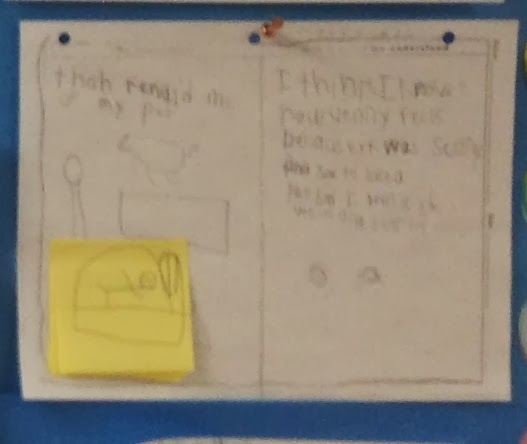
terrible quality . . . but you get the idea
We focus on Text to Self connections for a couple days. Each day we read a book, record our connections and discuss how it's impacting our understanding.

Snippets 

The snippet lesson comes from Strategies That Work.  To avoid long drawn out stories, it uses the book Snippets By: Charlotte Zolotow to illustrate how we can write about tiny pieces of our lives. I model choose a snippet from the text and connect it to my life, another text, or big idea. I then respond, by writing a snippet of my own. Students then choose a snippet and try to respond to it in their literacy notebooks.


Rating Our Connections Lesson

 One of the earliest reads I use is, Ira Sleeps Over by: Bernard Waber. As we read I give students opportunites to turn and talk about their connections. Since this is one of the first books, I offer some scaffolding by giving the students starting points. For example, "turn and talk about what you like to do a sleepover" or "talk about a time when you were excited for a play date like Ira is." After reading I have the students record one of their connections to a post-it and collect them for the following day.


The next day we discuss the difference between a deep connection and flat connection. I introduce the students to our Meaty Connection Picture Rubric. We discuss what makes a connection a deep connection and then rate the previous days connections on the rubric. We come to the conclusion that the best connections include details and feelings.


Some books that I use for Text to Self Connections: 
  • Lily's Purple Plastic Purse By: Kevin Henkes
  • Owen By: Kevin Henkes
  • Alexander and the Terrible, Horrible, No Good, Very Bad Day By: Judith Viorst
  • Earrings By:  Judith Viorst 
  • Knuffle Bunny By: Mo Willems
  • The Relatives Came By: Cynthia Rylant
  • The Snowy Day By: Ezra Jack Keats
  • The Two of Them By: Alikia
  • Andrew’s Loose Tooth By: Robert Munsch
  • Sick Day By: Patricia MacLachlan
  • My Rotten Red-Headed Older Brother  By: Patricia Polacco
Once students have a good understanding of text to self connections, we begin learning about the other types of connections. 

Three Types of Connections Lesson:

I begin by introducing an anchor chart and the three types of connection. I show the chain visual that they saw earlier for text to self, but this time add in the ones for text to text and text to self.


Then I begin reading Knuffle Bunny Too By: Mo Willems. Stopping and modeling my thinking.

Stop and Talk:
  1. When Trixis is excited to take her Knuffle bunny to school -  “ This reminds me of my first day of 7th grade, I was so excited to show all my friends my new outfit. It was the first time I didn’t have to wear a uniform, I was as excited as Trixie”   Explain that this a text to self connection, the TEXT is reminding you have something that has happened to mySELF (T2S).  I invite students to assemble their own text to self puppet.
  2. When Trixie has the bunny taken away - “This reminds me of Lilly’s Purple Plastic Purse. The teacher took Lily’s purse away. I remember that Lilly got it back at the end of the day, I bet the teacher will give Trixie her bunny back at the end of the day” Explain that is a text to text connection, one TEXT (Knuffle Bunny Too) is reminding me of another TEXT (Lily’s purple plastic purse)  (T2T).  Invite students assemble their own text to text puppet.
  3. When Trixie makes her first friend in Sonja - “This reminds me of how kids often make their first friend, it usually happens by accident because they have something in common.” Explain this is Text to World connection, because the TEXT is reminding of a big idea, friendship, that happens across the WORLD (T2W). Invite  students assemble their own text to world puppet.
Now that I have modeled for the students, I relinquish some of the responsibly and guide them through determining the different types of connections. We visit blue ribbon readers website. As students watch and listen to the children on the screen make connections, they hold up their puppets to indicate which type of connection it is. 


Finally, students practice this identification of different types of connections independently by listening to a song and writing their connection on post-it notes. They then stick their post-its on our chart by based on whether they made a T2S, T2T, or T2W connection.  Some song suggestions: Rachel Delevoryas By: Randy Stonehill, We’re going to be friends By: White Stripes, Popular By: Kristin Chenoweth, Old Blue By: Byrds, You’ve got a friend in me By: Randy Newman

 Text to Text Connections

 The next step is taking students through story comparisons. I span each set of books over 2 to 3 days. One day we read aloud and make text to self connections, then by day 3 we are comparing the two stories making text to text connections. 

Here are some book combinations:

Sometimes I'm Bombaloo and When Sophie Gets Really Really Angry
       

Dooby Dooby Moo and Punk Farm
   

Good Boy Fergus     and    No David


 Ira Sleeps Over   and   Weekend at Wendell's


Bootsie Barker Bites   and  Mean Jean the Recess Queen


At the end of the unit, we discuss all we've learned about connections and why we should record them and try to connect every time we read. Here is our final anchor chart.


I also end up with a lot of work samples from my kiddos to show their understanding of making connections.  Here are a look at some. 
Again I use a lot of the graphic organizers from Hello Literacy 

By the time we have finished this unit, students have made connections to so many characters, places, and themes. They have learned that through making connections, one can vicariously live through the pages.

"All good books are alike in that they are truer than if they had really happened and after you are finished reading one you will feel that all that happened to you and afterwards it all belongs to you: the good and the bad, the ecstasy, the remorse and sorrow, the people and the places and how the weather was."  –Ernest Hemingway