Monday, February 17, 2014

Comprehension Strategies: Schema Part 3 - Making Connections

Students learned that readers comprehend better when they actively think about and apply their knowledge of a book's topic as we tapped into our schema to read nonfiction. Now, I begin to teach students how they can use their schema to make connections to fiction stories. Stephanie Harvey and Anne Goudvis state, "When children understand how to connect the text they read to their lives, they begin to make connections between what they read and the larger world. This nudges them into thinking about bigger, more expansive issues beyond their universe of home, school, and neighborhood." (Strategies that Work, 2000)

So I start again by using a launching activity from Comprehension Connections (McGregor, 2007). Around the room I hang up four picture by Norman Rockwell - High Dive, Day in the Life of a Boy, Day in the Life of Girl, and Surprise. I have students browse the pictures with a partner. I encourage students to discuss what the pictures remind them of and leave behind a sticky with their thoughts.

They learn the first thinking/talking stems for making connections:
  • This reminds me of . . . 
  • I'm remembering . . . 
I explain that readers use their schema when reading fiction in lots of way, but for this first day I only show them one way, making text to self connections. I use a visual of paper clips joining a book and a die cut of a person. I tell them "Connections are like chains or bridges, they connect our schema with what we are reading. We hear our inner voice saying, 'this reminds me of . . '

The First Connection Lesson

My first read aloud lesson on making connections comes from Stephanie Harvey's Primary Comprehension Toolkit. As I read aloud Patches Lost and Found By: Steven Kroll, I model making a text to self  and text to text connections, explaining how it is helping me understand what I'm reading. I then guide student into jotting down and drawing their connections as I continue reading. After reading the book, I transfer my connection to a two column think sheet. One side states "My Connection" then other "How it helps me".  I explain how I was able to understand the character's emotions because I experienced something similar. Students try the same as I float and confer. We then share our think sheets.
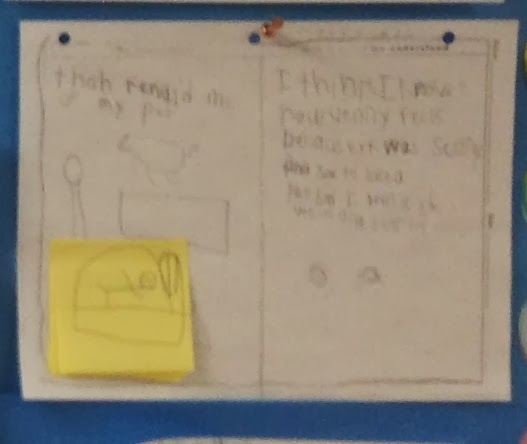
terrible quality . . . but you get the idea
We focus on Text to Self connections for a couple days. Each day we read a book, record our connections and discuss how it's impacting our understanding.

Snippets 

The snippet lesson comes from Strategies That Work.  To avoid long drawn out stories, it uses the book Snippets By: Charlotte Zolotow to illustrate how we can write about tiny pieces of our lives. I model choose a snippet from the text and connect it to my life, another text, or big idea. I then respond, by writing a snippet of my own. Students then choose a snippet and try to respond to it in their literacy notebooks.


Rating Our Connections Lesson

 One of the earliest reads I use is, Ira Sleeps Over by: Bernard Waber. As we read I give students opportunites to turn and talk about their connections. Since this is one of the first books, I offer some scaffolding by giving the students starting points. For example, "turn and talk about what you like to do a sleepover" or "talk about a time when you were excited for a play date like Ira is." After reading I have the students record one of their connections to a post-it and collect them for the following day.


The next day we discuss the difference between a deep connection and flat connection. I introduce the students to our Meaty Connection Picture Rubric. We discuss what makes a connection a deep connection and then rate the previous days connections on the rubric. We come to the conclusion that the best connections include details and feelings.


Some books that I use for Text to Self Connections: 
  • Lily's Purple Plastic Purse By: Kevin Henkes
  • Owen By: Kevin Henkes
  • Alexander and the Terrible, Horrible, No Good, Very Bad Day By: Judith Viorst
  • Earrings By:  Judith Viorst 
  • Knuffle Bunny By: Mo Willems
  • The Relatives Came By: Cynthia Rylant
  • The Snowy Day By: Ezra Jack Keats
  • The Two of Them By: Alikia
  • Andrew’s Loose Tooth By: Robert Munsch
  • Sick Day By: Patricia MacLachlan
  • My Rotten Red-Headed Older Brother  By: Patricia Polacco
Once students have a good understanding of text to self connections, we begin learning about the other types of connections. 

Three Types of Connections Lesson:

I begin by introducing an anchor chart and the three types of connection. I show the chain visual that they saw earlier for text to self, but this time add in the ones for text to text and text to self.


Then I begin reading Knuffle Bunny Too By: Mo Willems. Stopping and modeling my thinking.

Stop and Talk:
  1. When Trixis is excited to take her Knuffle bunny to school -  “ This reminds me of my first day of 7th grade, I was so excited to show all my friends my new outfit. It was the first time I didn’t have to wear a uniform, I was as excited as Trixie”   Explain that this a text to self connection, the TEXT is reminding you have something that has happened to mySELF (T2S).  I invite students to assemble their own text to self puppet.
  2. When Trixie has the bunny taken away - “This reminds me of Lilly’s Purple Plastic Purse. The teacher took Lily’s purse away. I remember that Lilly got it back at the end of the day, I bet the teacher will give Trixie her bunny back at the end of the day” Explain that is a text to text connection, one TEXT (Knuffle Bunny Too) is reminding me of another TEXT (Lily’s purple plastic purse)  (T2T).  Invite students assemble their own text to text puppet.
  3. When Trixie makes her first friend in Sonja - “This reminds me of how kids often make their first friend, it usually happens by accident because they have something in common.” Explain this is Text to World connection, because the TEXT is reminding of a big idea, friendship, that happens across the WORLD (T2W). Invite  students assemble their own text to world puppet.
Now that I have modeled for the students, I relinquish some of the responsibly and guide them through determining the different types of connections. We visit blue ribbon readers website. As students watch and listen to the children on the screen make connections, they hold up their puppets to indicate which type of connection it is. 


Finally, students practice this identification of different types of connections independently by listening to a song and writing their connection on post-it notes. They then stick their post-its on our chart by based on whether they made a T2S, T2T, or T2W connection.  Some song suggestions: Rachel Delevoryas By: Randy Stonehill, We’re going to be friends By: White Stripes, Popular By: Kristin Chenoweth, Old Blue By: Byrds, You’ve got a friend in me By: Randy Newman

 Text to Text Connections

 The next step is taking students through story comparisons. I span each set of books over 2 to 3 days. One day we read aloud and make text to self connections, then by day 3 we are comparing the two stories making text to text connections. 

Here are some book combinations:

Sometimes I'm Bombaloo and When Sophie Gets Really Really Angry
       

Dooby Dooby Moo and Punk Farm
   

Good Boy Fergus     and    No David


 Ira Sleeps Over   and   Weekend at Wendell's


Bootsie Barker Bites   and  Mean Jean the Recess Queen


At the end of the unit, we discuss all we've learned about connections and why we should record them and try to connect every time we read. Here is our final anchor chart.


I also end up with a lot of work samples from my kiddos to show their understanding of making connections.  Here are a look at some. 
Again I use a lot of the graphic organizers from Hello Literacy 

By the time we have finished this unit, students have made connections to so many characters, places, and themes. They have learned that through making connections, one can vicariously live through the pages.

"All good books are alike in that they are truer than if they had really happened and after you are finished reading one you will feel that all that happened to you and afterwards it all belongs to you: the good and the bad, the ecstasy, the remorse and sorrow, the people and the places and how the weather was."  –Ernest Hemingway

Comprehension Strategies: Schema Part 2 - Tapping Into Our Schema When Reading Non-Fiction

"Our responsibility is to help build students' background knowledge so that they can read independently to gain new information." - Strategies That Work


After helping students to understand this huge concept of schema*, we begin seeing how it influences our understanding of Non-fiction texts.


I teach student's to "tap into their schema" before they read a new nonfiction book. I explain that we have "mental files" that holds our schema for certain topics.  I create a reusable anchor chart that when closed looks like a file folder but when opened has a place for us to place our schema, new learning, and any misconceptions. I don't have a picture of my anchor chart available, but here is a "recreation".
As always I start by modeling, having the book up when I am reading and down when I am thinking. I let the students hear when I have an ah-ha moment, when I learn something new, and when I get a confused my new information, bridging it back to my prior knowledge. We move into shared studies of different informational texts, each time charting our thinking.

Here are some anchor chart examples of how you might chart your student's learning. I've posted the teacher's blog that they came from below for ideas on how they used them in class.
http://mscrowleysclass.blogspot.com/2012/01/penguins.html
http://thegoodlife-lindsay.blogspot.com/2011/10/creepy-crawly-spiders.html
http://mrswilliamsonskinders.blogspot.com/
Of course, I also expect students to record their own thinking and to practice this strategy independently.I use these graphic organizers from Hello Literacy. Her Common Core bundles are full of wonderful graphic organizers and ideas.


 Eventually, the students' reading binders become full of little mental files on different topics they read throughout the year.


*I've divided this topic into three posts: Part 1 - Introduction, Part 2 - Prior Knowledge and New Learning, and Part 3 - Making Connections.
*

Comprehension Strategies: Schema Part 1: Introduction

Now that students realize that reading is thinking and that good readers pay attention to their "inner voice", I can start to explain/name the strategies that their "inner voice" is taking them through. 

I start with explaining what schema is  using a strategy from Tanny McGregor's Comprehension Connections:
I name the word and explain it is all the things that they have in their head - like the people we know. I tell the students some small stories from my life, for example, how I love playing with my best friend, Jenna.  As I talk about some of our favorite games I write her name on small piece of paper.  I say "it's also the places we've been." I write down a vacation spot that my students have heard me talk and write about before. "It's also the things you know", writing down cooking on another strip of paper. I conclude giving examples of books I've read, experiences I've had, and information I've seen on T.V - each time writing the topic/person/place on small piece of paper. I can see their curiosity building - they want to hear more about my life and wonder why I am writing all this information down. Then I explain, as we go through life our brain remembers all this stuff. It's like a lint roller. Pulling out the largest roller I can find and rolling it over my strips of paper, I show students how all those little papers stick to roller just like the actual people and experiences are stuck in my head. This concrete visualization spurs students to start sharing their experiences and knowledge with one in another. They hurry to piles of paper strips on their desk and begin writing  . . . strip after strip. Comparing their knowledge to each other - already beginning the strategy of making connections.  "I've been to Disney too!" Then each student rolls up their schema and we display it as a reminder of how much we already know!
For homework, I ask students to complete The Many Pieces of My Graphic Organizer created by Linda Teese.
I also love this little creativity from  Amy at Milk and Cookies.


 The next day we begin learning how that schema, sometimes referred to as prior knowledge helps us understand our reading. We begin the lesson by doing the One Minute Determiner activity also found in Comprehension Connections. I split the paper into a t-chart. I write a familiar topic on one side. I give the students 1 minute to share their schema, writing it down as they shout it out. I repeat the activity on the other side with a topic I know they don't have schema for. Afterwards, I have students turn and talk about why there is such a different in the two topics. We sum up by writing SCHEMA down the right side. "Schema makes the difference!" I tell children I can tell they have a lot of schema for Cedar Point, but none for the Adirondacks. I explain that I have been to the Adirondacks so I have schema for it, sharing bits of my experience.

From here we beginning diving into Non-Fiction and use our schema to help us prepare to read and understand different non-fiction texts. Read about it in the post titled Comprehension Strategies: Schema Part 2 - Tapping into our Schema to Understand Non-Fiction.
*Once I finish writing up the entire Schema Unit, I will post my resources on my TPT store.

Tuesday, February 11, 2014

Writing Conferences

This year my school has adopted Lucy Calkin's Units of Study for Writing. Although I did teach her previous K-2 Units these new units feel a bit foreign to me. It could be because I taught the old units YEARS ago, it could be that she has added so much more to these new units, but its probably a bit of both.

Either way, I am very excited to be using this program again and am amazed at the progress I have already seen in my students as we make our way through the units.

Yes, my students are learning to write rich narratives, fact filled informative books, and persuasive opinion pieces! But I am also learning. Everything from how to hold a short yet effective mini lesson, engage in a purposeful conference, to holding a powerful mini-group. 

Today, I just want to talk about what I've been doing in the realm of conferencing. I've gotten pretty good at finding a compliment for my students, but I'm having a more difficult time with leaving them with a teaching point. To help, I have been referring back to the If . . . Then . . .Curriculum book a lot! If you haven't explored it yet, Calkins has so nicely laid out some typical "hiccups" students encounter within each unit. She provides the teaching language to help move students forward and goes as far as giving examples of short notes you can leave them with. So . . .here's where my ah-ha came in. I wanted to have those notes quickly accessible so my students could keep them on their goal sheet as a reminder of our conference's teaching point. But I don't have time to dry each one out and I don't have the money to print them all up on expensive labels. Therefore, I began seeking out a more timely and cost effective way to leave "tracks" behind my conferences. I decided to create a document where I could print those goals onto post-its. Now I keep them with me and just pull one off when I need it and stick it right to the student's goal page. Here is an example of my first draft coming out of the printer.

Since then, I've made some tweaks to the document and it seems after day 1 - I can say I think it's working BEAUTIFULLY!  So far I have only made the post -it notes for the informational unit, but I plan on making these for the narrative and opinion units as well once I get to them. I'm making two sets. One of them has the problem statement on the top and the other doesn't. You can pick them up at my TPT store - free for a limited time!

Here's what I did:
In my writing conference folder I printed out the pages from the  If . . . Then . . .Curriculum and just stuck the post-its that matched in the last column. I made sure to print multiple copies of each post-its.

Happy Conferencing!

Friday, February 7, 2014

Comprehension Strategies: Metacognition

“As soon as I open it, I occupy the book, I stomp around in it. I underline passages, scribble in the margins, leave my mark – in effect I write my own book, a counter version. I’ve come to understand that there are two dramas in reading: the drama of the book’s internal relations and the drama of its relation to me” 
Anatole Broyard
 
Each year I know that I am going to take my students through explicit instruction in all of the reading comprehension strategies. Sometimes, we refer to these as metacognitive strategies, because they are really the thinking strategies readers use as they try to understand the text.

So before I teach students the strategies I start by teaching them to pay attention to that "inner voice" and start to think about their thinking (metacognition). I teach them that reading is thinking. Many students will buy into the fact that yes, they need to interpret the characters on the page and think the sounds those symbols make to create words. But many children believe the thinking stops there, and unfortunately some teachers too. This first unit, teaches students to make meaning from their reading.

I start by letting the students see my thinking. I explain that when the book is up I am reading and when the book is down I am letting them hear what is going on inside my head, I refer to this as my "inner voice" and sometimes make my hand look like a little mouth and share my thinking using a squeaky voice.

So I begin by using a strategy from Comprehension Connections, called the Reading Salad.

I have two helpers, one holds container full of green paper which represents my "thinking" and another student holds a container full of red paper, my "reading".  As I read and think aloud they drop the corresponding color into a large salad bowl, labeled "real reading."


Children see that real reading has a lot more thinking in it than actual reading. I model thinking about everything from unfamiliar vocabulary, to character development, to predictions, and questions. 

After modeling "real reading" students share out some of the things they noticed about my thinking. In our reader's notebook students create a picture of the reading salad using ripped construction paper and list some of the thinking they could do when they read. 


Then I teach my students that some of the thinking that good readers do, is just stopping periodically during their reading and checking to make sure they understand what they have read. I teach them the Check For Understanding song. (This idea comes from the "two sisters" - CAFE and Daily 5.) 

Check For Understanding Song (sung to the tune of Hokey Pokey)
You have a great new book 
and you’ve started to read
You know a lot of words but
 here’s something else you need.
You must check for understanding
and ask “Who?” and also “What?” 
that’s what reading’s all about!

Of course the next step is modeling how a reader "checks for understanding."  I distribute check for understanding bookmarks to each of the student. Then, I read a few pages of a book and stop to refer to my check mark. I ask myself the questions on the bookmark to make sure I know what I am reading. If I can't answer the question, I go back and reread to find the answer. I don't have a picture of mine available but here are some from Christina Bainbridge. Mine are available on my TPT store for free, along with other documents to go with the Metacognition Unit.
These are from Christina Bainbridge and for sale at Teaching Oasis! 


Finally, I spend the rest of the week modeling thinking while reading. Each time releasing the responsibility more and more to the students. Each day we notice what we do as good readers and add it to an anchor chart titled "Reading is Thinking" with subheadings of Before, During, and After. Below is a sample of some of the things that might make it on your anchor chart.


BEFORE
DURING
AFTER
Predict what may happen
Connect to Background Knowledge (Schema)
Make Connections

Make connections to what you know about the topic
Connect sentences together for meaning
Ask yourself questions you still have
Ask yourself questions that you think will be answered as you read
Notice something about the author's language or style
Reflect on what you have read
Set goals/purpose for reading
Visualize
Summarize major points
Note organization of text
Ask yourself questions
Look for additional information
Create a mental overview
Evaluate your predictions


For the rest of the unit, students put into practice what we have been doing as a class. They use the check marks during independent and buddy reading, complete graphic organizers where they track their thinking, and share the process during whole group and guided reading groups.

"When readers interact with the texts they read, reading becomes important. Reading shapes and even changes thinking. Getting readers to think when they read, to develop an awareness of their thinking, and to use strategies that help them comprehend are the primary goals of comprehension instruction." - Stephanie Harvey and Anne Goudvis from Strategies that Work